
Sir, It has come to my attention that you intend to publish an article highlighting various obscure cases from the University’s Disciplinary Reports that I may only describe as borderline libelous. As an eminent member of the College faculty who has personally dealt with several similar cases to those to which you refer, I find myself appalled.
I urge you then, in the name of free inquiry and discourse—values which you claim to hold most dear—to print this letter if you do indeed decide to publish the piece I am referencing. (Needless to say, if you instead refrain from publishing or choose to alter the piece significantly, you must not print this letter.) [Editor’s note: we have decided to significantly alter, and therefore refrain from publishing, the aforementioned piece. It will be available online or in the next issue of the magazine.]
My goal is simply to educate your readers and provide some much-needed context—some of which must surely have been withheld with malicious intent by your writer (who must think himself quite clever) but most of which (quite worse) is merely due to his ignorance and obvious buffoonery. I made some inquiries into his background and was unsurprised with my findings: a business economics major. My deepest sympathies to the poor fellow.
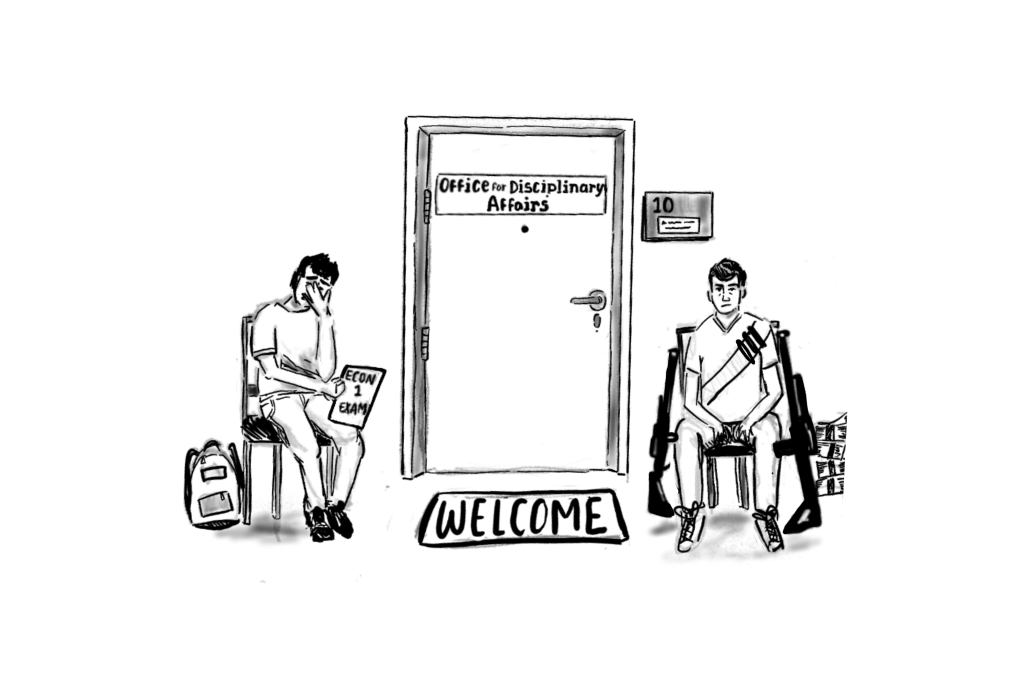
A student was charged with violating Booth’s standards of professionalism, specifically the student failed to follow the directive of a University official by not informing the Associate Dean of a conviction of two felony counts by a federal jury for importing and possessing/transferring machine guns. The ADC concluded the student was responsible and issued a four-quarter suspension.
I do not pretend to understand why The Phoenix intends to include this particular case in their article. Excepting the lurid details, this case has nothing to do with the College disciplinary system (since it occurred in Booth). Regardless, I was privy to some of the details of this case and found the punishment quite adequate. It is unclear to me how the sole regrettable fact—that the student involved is presently incarcerated for additional crimes— should be construed as any kind of error on the part of Booth: the University is a school, not a prison, and as such bears no responsibility for the recidivism rate of its detainees.

A student accused of changing responses on two examinations before submitting them to the professor, thereby resulting in an inappropriate grade assignment, was brought before the disciplinary committee. The committee found the student responsible for academic misconduct and imposed a nine quarter suspension.
The College could punish no greater criminal than one who overtly destroys the sanctity of examinations— the foundation of our entire education system. Yet, hypocrite students, perhaps even you, reader, will boil with rage seeing this case contrasted with the one above. This, I suspect, was the point of the writer’s irrelevant tangents: to stir up outrage and create the impression that the disciplinary system is at once both too indulgent and too draconian. This is, of course, a contradiction in terms—but, alas, if the brain’s cold logic could temper an unfairly provoked heart, our world would be quite different.
A student was accused of physical abuse…this student was alleged to have struck the security officer in the face and throw the officer to the ground. This student was found responsible, placed on probation for the rest of this student’s time in the College, and advised to seek counseling.
Again, The Phoenix abuses the privileges of openness and transparency that we, a private university, have graciously extended to the disciplinary system for the sole purpose of producing sensational dreck.
In the fourth case, a disciplinary committee hearing was held for a student accused of academic dishonesty. The facts of the case were not disputed. The student was accused of plagiarizing a BA thesis draft. The student explained that it was due to poor mental health and difficulties with self-care. The disciplinary committee imposed a two quarter suspension.
Justice and mercy. Punishment and pardon. The right to discipline inevitably entails a right to forgive, for who among us is without some greater or lesser sin? To pooh-pooh the capacity of the disciplinary system to lessen its punishment after weighing relevant considerations is to attack the principle of discipline itself.
The seventh case involved a student accused of academic dishonesty. The student was accused of forging the TA’s signature for a French conversation session that the student did not attend. The committee found the student responsible and imposed a three quarter suspension.
There is nothing I detest more than a liar. Those who lie, even for the smallest of gains, have been irredeemably corrupted. It is only to credit the infinite mercy that the College extends to the most loathsome offenders that this student was not expelled on the spot. That was certainly my recommendation in this case, ignored as it were by the rest of the Area Committee. Nevertheless, I must stand proudly by the decision of the disciplinary system, even in a case such as this: an academic murder done for a penny’s gain.
Sincerely,
An Eminent Professor



 uchicagophoenix.com
Leave a comment