
“I am a South African Jew”—a statement often followed by a pause, a wrinkling forehead, and a “Wait— are there a lot of Jews in South Africa?”
The South African Jewish population sits at roughly 50,000—a close-knit community of Lithuanian babkas, boerewors barbecues, religiosity ranging from Hasidic black hats to crop-top conservatives, and synagogues on every corner in the five-by-five kilometer radius that we call ‘Jew-ville’. Despite being at the southern tip of Africa, I have been conscious of the land of Egypt since I was little. Mitzrayim (Biblical Egypt) is a cornerstone of the biblical narrative of the Jewish people. As the first Jewish diaspora, we read about its pharaohs and pyramids, our community’s prosperity turned to slavery, and our yearly Passover—a celebration dedicated to our leaving its prison. It has always been a place of fascination in the mind of the Jew.
I arrived in Egypt on a Friday morning in the first week of 2025—not due to a biblical famine, a Spanish expulsion, or a Roman invasion, but as a student from the University of Chicago to study Middle Eastern civilizations and Arabic. That Shabbat I was in a hotel room reading the parsha (the weekly chapter of the Torah) with the bustle of Cairo so loud I could only just hear my thoughts above the incessant hoots of cars, barking dogs, and chatter.
Do not be afraid to go down to Egypt, for there I will make you into a great people…They took their livestock and their possessions that they had acquired in the land of Canaan and came to Egypt, Jacob and all his offspring with him: His sons and his grandsons with him, his daughters and his granddaughters, and all his offspring, he brought with him to Egypt.” (Genesis 46:3-7)
The coincidence made me chuckle with a strange sense of safety; Jacob and his family were arriving alongside me in this foreign land of donkeys and Pharaohs.
I didn’t arrive in Egypt due to a biblical famine, a Spanish expulsion, or a Roman invasion, but as a student from the University of Chicago
Egypt is not just a biblical story for the Jewish people but a country that, as I will come to learn, has housed my people for millennia. The story of Egyptian Jewry is part and parcel of the story of Egypt itself. The biblical stories of Joseph and Jacob coming down to Egypt in famine, a centuries-long slavery, and a final Exodus are only the beginning of this millennia-long history.
In 930 BCE, the Judean King Solomon married Pharaoh’s daughter. In 586 BCE Jews fled to Egypt after the Babylonian destruction of the First Temple of Jerusalem. By 300 BCE, a thriving community of Jews had grown in Alexandria under Alexander the Great’s Ptolemy Ι. We saw the creation of the Septuagint (the Greek translation of the Torah), the birth of mystical Judaism (Kabbalah), the emergence of Jewish Hellenism, and the building of synagogues. In the 7th century CE and onwards, Jews continued to live in Egypt under Islamic rule, building communities under various Islamic dynasties.
Walking through the sanded, donkey-filled streets of Giza and the fields of Fayoum, I see them plowing sugar cane and building with sandstone. In the night of the Sinai Desert, I am alongside them as we walk up Mount Sinai to the tune of Arabic songs and camels.
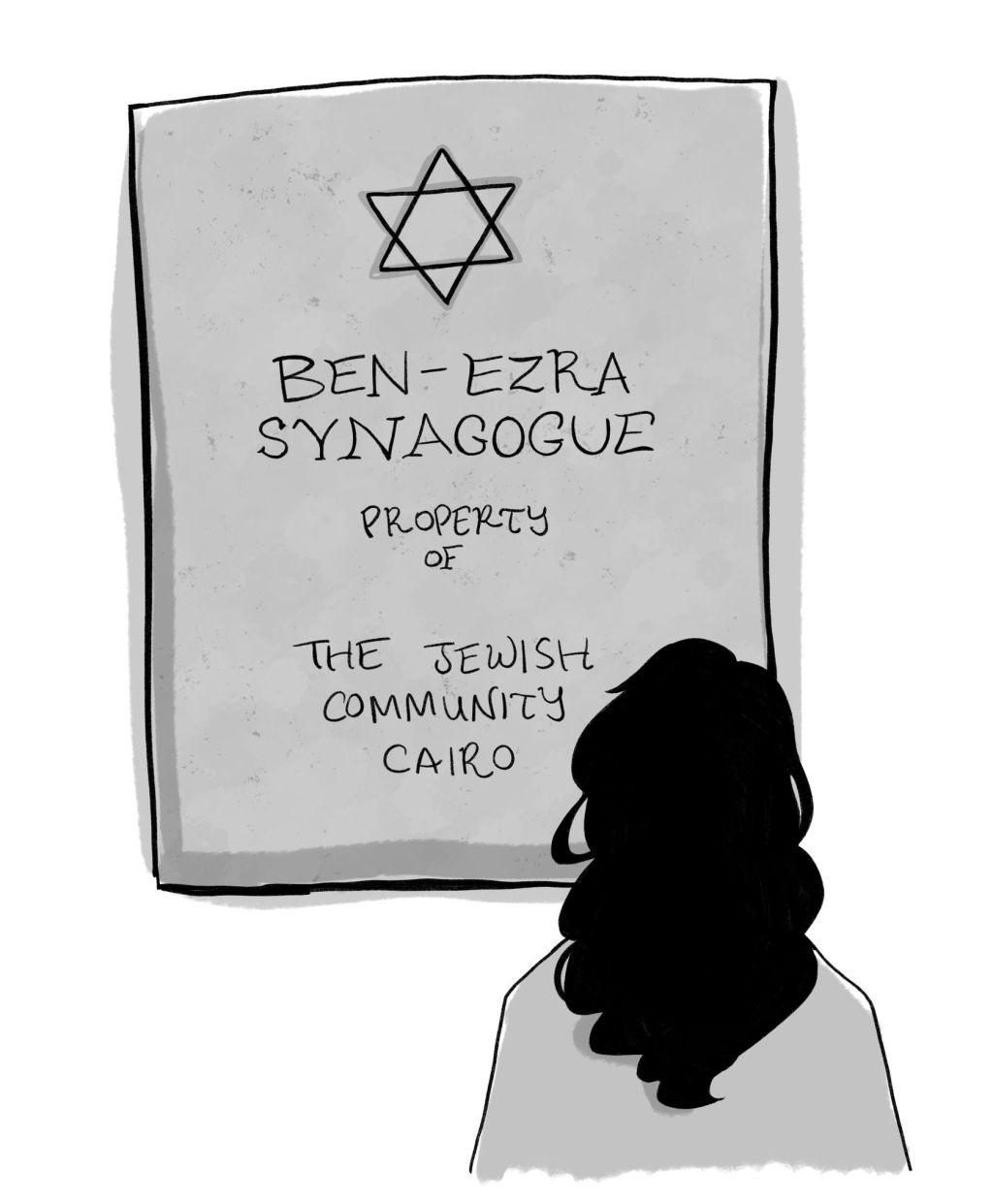
On one of our touring days we arrive at Ben Ezra Synagogue: a small building tucked away in the alleys of medieval Fustat, now Coptic Cairo.
Walking into the Ben Ezra synagogue, it immediately feels like the two-tiered synagogue I grew up with in Cape Town. Its wooden inlays, center bimah, Ten Commandment tablet panes, and Stars of David are etched into its artistic designs just like those in mine. And yet there is a different feel to Ben Ezra’s marble curves and arches, lanterns and wooden lattice walls: it is a product of its time and place. Built in the basilica style of ancient Roman architecture, its marble and golden designs feel European. Its classical Islamic mashrabiya and copper lanterns are similar to those seen in the mosques of Old Cairo. The most striking feature, however, is the large slab of marble engraved with gold Hebrew writing in the front atrium: the story of Moses.
ויצא משה ויפרוש כפיו אל ה’ וקבלה כידם כי במקום הזה היתה תפלתו
And Moses went out and spread out his hands toward the Lord, and he accepted them as his hands, for in this place his prayer was.

As the biblical story goes, baby Moses was found in the Nile reeds close outside Pharaoh’s palace by his daughter Batya. It is in a palace where Moses grew up for the first 40 years of his life and where, according to the legend and as the slab states, the Ben Ezra Synagogue now stands. Like most buildings in the Old City, its history only begins in biblical times. In 882 CE, the Coptic Christians sold their church to the Jewish community and the Ben Ezra synagogue was born. It did not last long. The original building was destroyed in 1012 by Fatimid Caliph Al-Hakim, a known persecutor of Sunni Muslims, Christians, and Jews during his reign. The synagogue was rebuilt shortly after, in 1025, before Fatimid Vizier Shawar burned the entire city of Fustat to prevent a Crusader invasion and the synagogue along with it. Hearing this reminds me of the December 2018 fire that destroyed my Cape Town synagogue, consuming our Torah scrolls and leaving us spiritually homeless, much like what the Egyptian Jews of the 12th century must have felt.
Just as our synagogue was rebuilt, so too was the Ben Ezra synagogue, this time under Saladin (the Ayyubid Sultan) along with the rest of Fustat a couple of years later. It was then that the famous philosopher Maimonides, escaping persecution in Spain, prayed at Ben Ezra and religious rationalist philosophy took shape. And then the Geniza archive—an attic silo preserving documents bearing God’s name—became an unintended yet invaluable record of daily life of the time, including Maimonides’s own writings. This synagogue has not only lived alongside its community through centuries of turmoil and reignition but also holds its very words in its walls. And here it stands centuries later, a 21st century Jewish traveler standing under its roof.
There are no longer many places in Egypt to feel Jewish. I can count the population of Jews, which is “classified” by the government, on my fingers. With the church crosses and mosque minarets spanning the red-sun desert landscape it is difficult to make sense of the disappearance of a Jewish community once so embedded in Egyptian society. Egypt is a place in which our nation was born and prospered, and yet it is a place of torment and persecution in the same breath. But in the Ben Ezra synagogue, in the fields of Fayoum, and on the rocks of Mt. Sinai, the ancient whispers of Egypt’s landscape are a biblical revival and medieval transportation. I am far from a lonely wandering jew.



 uchicagophoenix.com
Leave a comment