

Welcome to The Phoenix’s weekly digest. Every week during the quarter, you can expect our writers’ takes on some campus happenings.
This week, Calvin Swedene discusses his findings from the Institute of Politics’s well-attended “Politics of Your Situationship” panel.
Believe me, the last thing I wanted to be was the Cupid of The Chicago Phoenix. But, whether I like it or not, I have had this illustrious role thrust upon me. Because of this, I spent my Tuesday evening on the third floor of Ida Noyes listening to my peers unpack their love, loss, and other such misadventures at the “Politics of Your Situationship” event hosted by the IOP.
If you’re confused already, don’t worry—everyone there was too. Confused why our host desperately wanted to talk about the “Me Too” movement, confused about the significance of age gaps (not just in dating, but also in dating advisory), and confused (perhaps most of all) about how our generation could have messed up so badly that we need experts and evidence to tell us how to interact. I’d like to alleviate some of this confusion by relaying what the experts said about our ills and fine-tuning their prescription.
The panel of speakers included a Johns Hopkins professor, a Gen-Z researcher, and the IOP’s senior director. Some of their remarks were salient, albeit trite (“You may feel alone, but you’re alone together”, and the like), but others missed their mark entirely. Claims that Gen-Z “isn’t drinking anymore” or “is scared their advancements come off as harassment” came off as alienating rather than relatable. The student responses made it clear that—at UChicago, at least—this is far from the case. For example, UChicago students do not identify much with the so-called “analogue renaissance”; in fact, several vocal students said that dating apps were where the action was, for better or worse. Still more remarked that “situationships are…enjoyable” and conducive to a fast-paced academic life.
Much of what the unabashed attendees said about their love lives could be said about their social lives in general. For example, the most enduring relationships often form within a community, when we’re not looking for them—not when we deem ourselves stable enough to take a risk on someone who checks off a few of our “non-negotiable” boxes.
The same can be said for joining a club or discovering a new interest—we don’t suddenly decide, “I have some free time this week; I think I’ll go bouldering, if it meets my standards for extracurriculars,” or, “I’ll pick up the next campus publication I see—if I don’t like it, I swear I’m done reading them until next quarter.” No, we find and appreciate such things by chance: by asking a friend what’s there to do, by being forced to attend an obscure talk or dance recital or St. Augustine reading group, or even by scanning a QR code from a poster above a toilet.
At UChicago, we struggle to interact with each other because our shared sense of community is not strong enough to create the mutual goodwill that occasions such encounters. It’s obvious people want them—a dating workshop held by the Institute of Politics was close to bursting on a weekday, and the occasional cry for help on Sidechat is always met with unstinting words of encouragement. The question, then, is what we will do as a student body to meet our own social needs?
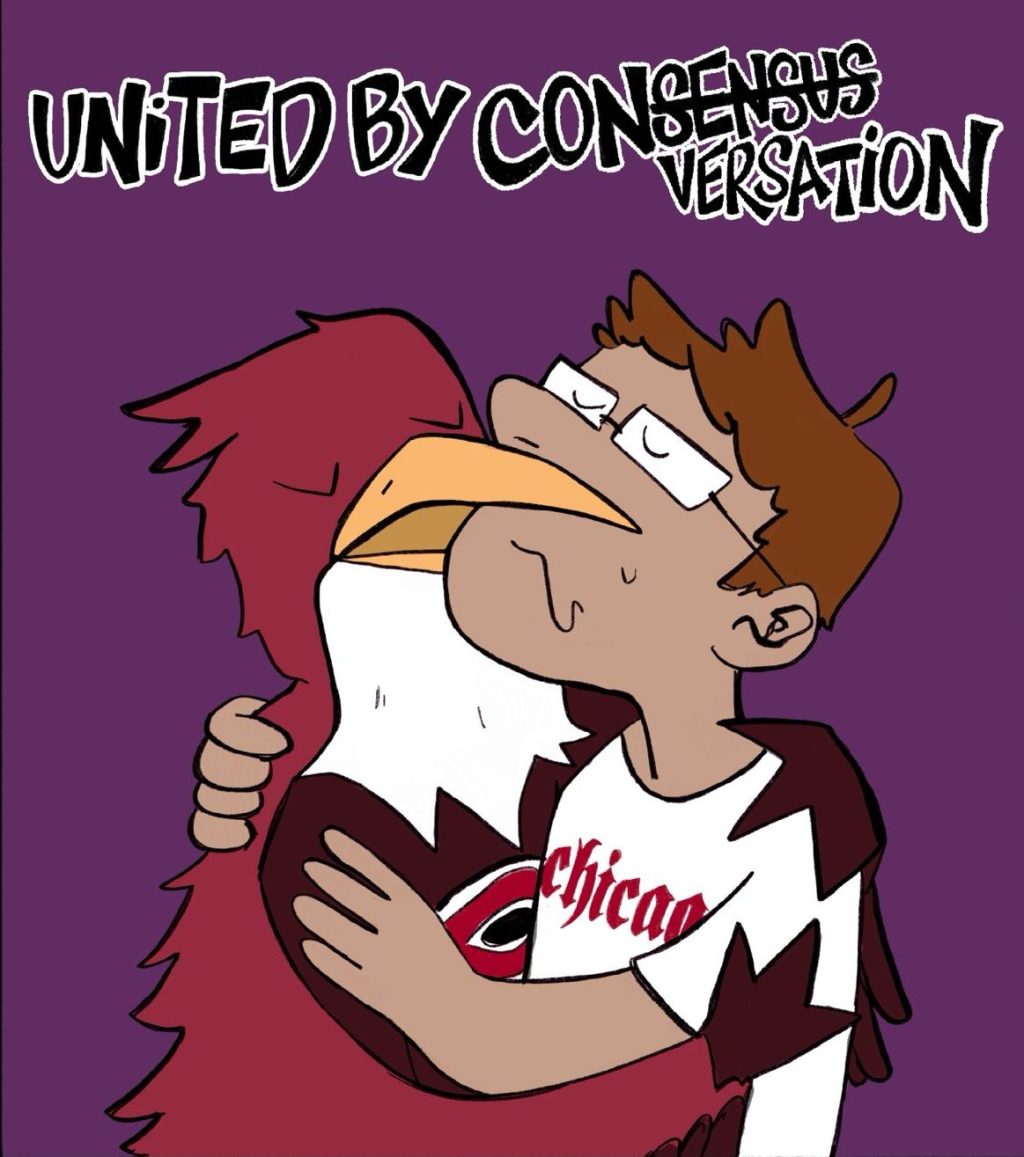
The panelists had their answer: make communication a priority, give the second date a chance, and be exclusive. The Phoenix offers its own: make conversation a priority, be generous with your time, and serve your community, not your concupiscence.
Stay tuned for next week’s edition. In the meantime, if you have any thoughts, disagreements, or words of support, we want to hear them! Write to us at thechicagophoenix@gmail.com.




 uchicagophoenix.com
Leave a comment