

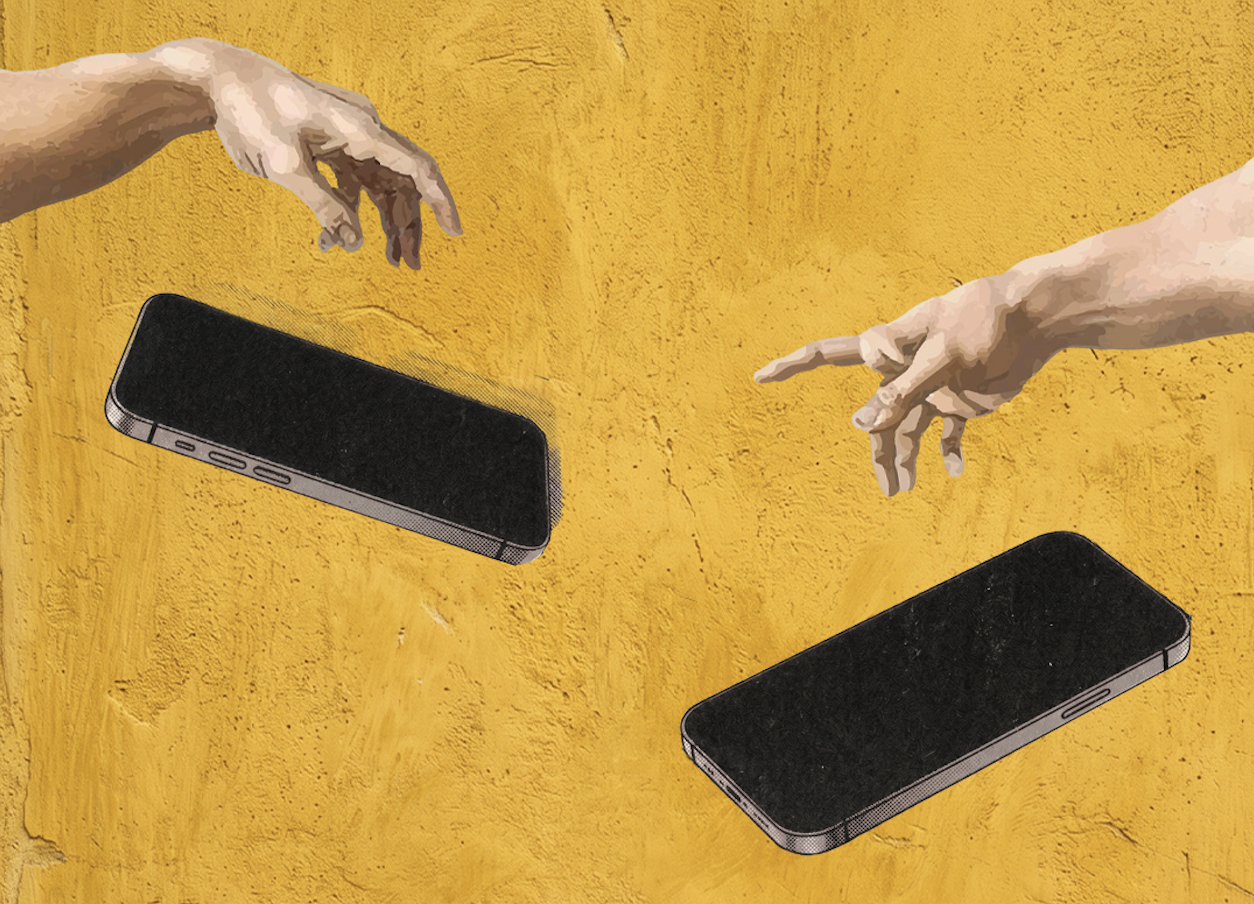
Last month in a Lincoln Park café, I sat with an old coworker for coffee, and he pitched me an idea that he had been turning over with his friends: “We want to host a party where phones aren’t allowed. You leave it in a bucket by the door, and if we see you with a phone, you’re out.” I thought it was a fantastic idea, but a pipe dream.
Last Saturday, in the backyard of a blue house on Hamlin Street in Evanston, two hundred Northwestern students gathered, phoneless, for the afternoon.
‘PHONES IN THE BOX’ read the sign as I walked through the side gate. I peered in, finding only a few. I thought the worst—that nobody had listened, that the great social experiment would never be tested. Instead, the majority of the crowd had left their phones at home. “I just want to go an afternoon without it,” a girl said pleadingly, as if asking of herself. “I don’t want to pick it up yet.” It had been four hours.
According to Eventbrite, the number of “phone-free” club events globally increased by 567 percent in 2025. There’s a certain spontaneity (a quality that 79 percent of young adults think is important to live events) inherent to the rhythm of a phoneless conversation, an afternoon stretched out in front of you where you do not know the time of day. You are present enough to change your plans, to do something exciting, and to be empowered and reckless enough to follow through.
And it wasn’t even jarring. The afternoon was a scene so natural, so human, that it didn’t strike me as odd. There, it was as if the most vibrant areas of social life existed once again, without the urge to inevitably retreat into one’s phone during a lull in conversation. MIT sociologist Sherry Turkle said that 89 percent of Americans admit to taking out their phone during their last social interaction. 82 percent said that it deteriorated the conversation they were in.
I’m certainly guilty of the phone fall-back, and my empty pocket made that all the more clear. I therefore rode the Red Line home with two observations. The first is that we are a culture wholly dependent on photos. We like to take them, and we love to show them. We identify mutual friends through Instagram profile pictures; we tell a story so we can use a picture as proof. We rely on what we think we can easily show rather than attempt to say. There were moments when I had the knee-jerk reaction to grab my phone from my pocket to pull up a photo but found my pocket empty. I was forced to use my words. To show pictures isn’t a bad thing. But we forgo something in the art of storytelling and observation when we rely on them to tell the story for us. This was a good exercise in working through memory.
The second observation is that our phones prevent us from starting conversations more than they degrade the conversation we’re already in. Why would you strike up a conversation with a stranger when you could text your friends about how much you don’t want to strike up a conversation with a stranger? It acts as an acceptable social crutch—something to soothe the sting of the awkwardness you feel when you enter a room full of strangers, or worse yet, when there’s somebody that you’d rather not see at all.
It’s getting into the conversation that the phone makes so hard. But it’s good (and quite funny, though usually in hindsight) to put yourself through those moments of unease. It’s a very useful skill to learn how to smile and nod and respond politely to a raging lunatic. It is good to know how to turn a painfully mundane conversation—say, about average humidity across cities in the U.S.—into a tolerable one. To hit the escape button is to atrophy our muscles of self-confidence, self-assurance, and good humor. When you relinquish your virtual world, you have no choice but to live where you are. That, as it seems to me, is what we are missing most of all, and we don’t even know that we’re missing it.
These events work because everybody there wants them to. That’s the appeal: they are gatherings of people who want to rid themselves of the social crutch just as much as you do, groups that want to make the awkward small talk cool again until you hit upon something really great. Everybody at that party wanted to trap themselves in that backyard. They wanted to relieve themselves of the allure of an online escape. They had a great time, but they won’t have any photos to prove it.



Leave a Reply